Short answer: if you want a ring that still looks new after ten years of daily wear, choose tungsten carbide. If you want the lightest possible band, work with your hands around hard impacts every day, or have very reactive skin, titanium is the safer pick. Both are far tougher than gold or silver, neither will rust or tarnish, and both are priced well below precious metals in South Africa. Here is how they actually differ, point by point.
Tungsten vs titanium at a glance
| Property | Tungsten carbide | Titanium |
|---|---|---|
| Hardness (Mohs scale) | About 8.5–9 (only diamond, sapphire and a few ceramics are harder) | About 6 (similar to hardened steel) |
| Scratch resistance | Virtually scratch-proof in normal wear; keeps a mirror polish | Picks up fine scratches; a brushed finish hides them |
| Weight of an 8 mm band | Heavy and solid – roughly three times the weight of titanium | Very light – you can forget you are wearing it |
| Impact | Hard but brittle: a hard knock on tile or concrete can crack it | Tough: it dents or bends rather than cracks |
| Resizing | Cannot be resized – exchange for a new size instead | Usually cannot be resized either; some jewellers manage half a size up |
| Emergency removal | Cracked off in seconds with locking pliers | Needs a diamond or carbide ring cutter |
| Skin reactions | Nickel-binder tungsten is hypoallergenic for most people; avoid cobalt-binder rings | Fully biocompatible (the same metal used in implants) |
| Colour and finishes | Natural gunmetal grey; polished, brushed, black, gold and rose-gold coatings, wood and shell inlays | Lighter silver-grey, usually matte; black and coloured coatings available |
| Typical price in South Africa | R1 300 – R1 800 for a branded ring with a warranty | Comparable; cheaper imports exist in both metals |
Scratches: the biggest everyday difference
Tungsten carbide sits at about 8.5 to 9 on the Mohs hardness scale. In practice that means keys, coins, gym equipment, tools and sand will not leave a mark on it, and a polished tungsten ring looks the same on its tenth anniversary as it did on the wedding day. That is the single biggest reason tungsten has become the default choice for men’s wedding bands.
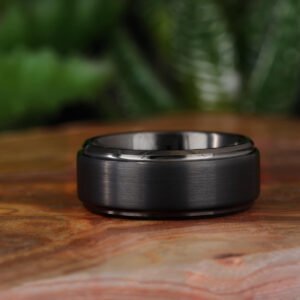
Titanium is strong for its weight, but it is not especially hard – around 6 on the same scale. It will scratch in normal wear. A brushed or matte titanium ring hides this well and can be re-brushed by a jeweller, but a polished titanium ring will dull within months.
Weight and feel
This is where the two metals feel like opposites. Tungsten carbide is dense – an 8 mm tungsten band has a reassuring heft that many men describe as feeling “like a real ring”, closer to gold or platinum than to steel. Titanium is one of the lightest metals used in jewellery; a titanium band weighs about a third of the same ring in tungsten and is easy to forget on your hand. Neither is right or wrong. If you have never worn a ring before and worry about it feeling bulky, titanium is gentler to get used to; if you want to feel that it is there, tungsten.
Impact: hard is not the same as unbreakable
Hardness and toughness are different things. Tungsten carbide is extremely hard, which is why it does not scratch, but it is also brittle. Drop it onto a tiled floor from standing height or slam it against concrete and it can crack or shatter. Titanium is the opposite: it scratches, but it will absorb a knock and at worst dent or go slightly out of round.
For most people this never comes up – tungsten rings survive decades of office work, driving, gym sessions and weekend DIY. If your job involves heavy hammering, climbing or working around machinery, consider titanium or, better still, take the metal ring off and wear a silicone ring at work.
Resizing: neither metal makes it easy
A tungsten carbide ring cannot be resized at all – it is too hard to cut and cannot be soldered, and heating it to bend it will crack it. Titanium can sometimes be stretched up by about half a size, but many jewellers decline the job. With either metal, the realistic answer to “it doesn’t fit” is a size exchange, which is why it matters to measure properly before you order. Use our ring size guide, measure at the end of the day when your fingers are at their largest, and if a ring you buy from Shelby still doesn’t fit, you have 30 days to exchange it for another size.
Emergency removal
A common worry, and a point in tungsten’s favour. If a finger swells after an injury, a tungsten carbide ring is removed by cracking it: emergency rooms clamp ordinary locking pliers across the band and tighten until the ring fractures and falls away, which takes seconds and does not cut into the finger. Titanium cannot be cracked and has to be cut through with a diamond-tipped or carbide ring cutter, which takes longer. Both are routine procedures; neither metal is a reason to avoid wearing a ring.
Skin sensitivity
Titanium is completely inert on skin, which is why it is used for surgical implants. Tungsten carbide rings are made of tungsten carbide powder bound with a small amount of either nickel or cobalt. Nickel-binder rings, which is what reputable jewellers sell, are hypoallergenic for the vast majority of people, including many who react to nickel in cheap costume jewellery, because the nickel is locked inside the carbide. Cobalt-binder rings are cheaper to make, can oxidise and are the usual cause of skin reactions blamed on “tungsten” – so ask what the binder is before you buy a very cheap import.
Looks and finishes
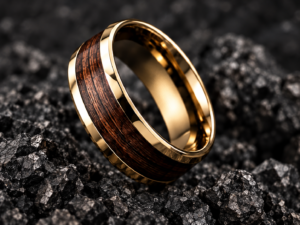
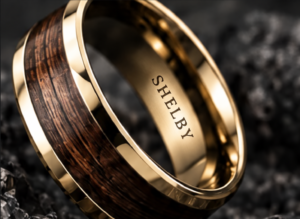
Raw tungsten carbide is a dark gunmetal grey that takes a mirror polish, and because the surface does not scratch, coatings and inlays last well on it: brushed and polished combinations, black and gold plating, rose-gold edges, and real wood, shell and carbon-fibre inlays. One honest note that applies to both metals: a black or coloured ring is a coating over the grey metal. On tungsten it is durable but will eventually show wear at the edges after years; on titanium it wears faster because the softer metal under it scratches. Titanium’s natural colour is a lighter, slightly warmer grey and most titanium rings are matte or brushed.
Price in South Africa
Both metals are affordable compared with gold. Expect to pay R1 300 to R1 800 for a branded tungsten carbide ring with a proper warranty from a South African jeweller; wood-inlay and two-tone designs sit at the top of that range. Unbranded imports sell for R400 to R900, usually with no warranty, no information about the binder and a thinner coating. Titanium rings from local jewellers sit in a similar bracket. Shelby’s men’s tungsten rings are priced from R1 350, carry a 24-month manufacturing warranty and can be engraved in-house from R150.
So which should you buy?
- Choose tungsten carbide if you want a ring that keeps a polished, scratch-free finish for life, prefer a solid weight on your hand, like the look of black, gold-edged or wood-inlay designs, and work a normal job.
- Choose titanium if lightness is your priority, you take hard knocks at work or in sport and would rather dent a ring than crack it, or you have skin that reacts to almost every metal.
- Choose silicone for the gym, the workshop and anywhere a metal ring is a safety risk – many men own a tungsten ring for daily wear and a silicone band for work.
Ready to compare designs? Browse Shelby’s men’s tungsten rings – every ring is delivered across South Africa in 3 to 5 working days, and you can add a personal engraving or a fingerprint on the product page.
Frequently asked questions
Is tungsten stronger than titanium?
Tungsten carbide is much harder (it resists scratching), but titanium is tougher (it resists cracking). Which one is “stronger” depends on whether you mean scratches or impacts.
Do tungsten rings turn your finger green?
No. Green marks come from copper in cheap alloys. Tungsten carbide and titanium contain no copper and do not tarnish or oxidise in normal wear. A cobalt-binder tungsten ring can occasionally cause skin irritation, which is why nickel-binder rings are the standard.
Can a tungsten ring be cut off in an emergency?
Yes – it is cracked off with locking pliers rather than cut, and it is one of the quickest rings to remove.
Which lasts longer, tungsten or titanium?
Both last a lifetime structurally. Tungsten keeps its original finish far longer; titanium gradually gains a patina of fine scratches unless it is re-brushed.